
 Hãy copy liên kết sau và gá»i tá»›i bạn bè nhé:

About Medieval Combat Society
Ever wanted to learn how to fight like a knight? With MCS you can learn the art of medieval combat, mastering the sword, spear, axe, mace, polearms, really big stick, and other jagged, sizeable, and otherwise dangerous-looking implements. You don’t need any kit to join in the fun. We provide you with all the necessary equipment and training. If you're interested in the historical world and socialising with what can only be described as a very interesting set of characters with rather a unique sense of fun, or if you just want to try out the best historical violence on our side of Lenton - then drop by!
Training Sessions
Ok, but where exactly am I meant to drop and when?
(Covid restrictions permitting) we hold training sessions twice per week. Sessions last for 3 hours and are normally followed by informal drinks in Mooch. Training normally takes place in The Studio in the Portland Building on University Park Campus (it's just opposite Mooch), but sometimes we train in other venues, including outdoors when the weather allows. Join our discord or our facebook group to keep up to date on where the next session is taking place.
Training Session Times
Wednesday: 6:30pm - 9:30pm
Sunday: 3:00pm - 6:00pm
Trips
Is that all you guys do?
We hold a handful of irregular events throughout the year too.
Christmas Dinner
As the yuletide season draws near, the jolly folk of MCS gather for their annual festival of shoving as much food as they can down their throats. We traditionally hold our christmas dinner at an all-you-can-eat buffet in the city.
TORM
The Original Reenactors' Market ("TORM") is a gathering of suppliers of replica historical clothing and equipment. It is a truly magical place where you can find all the swords that your heart desires, then return home to discover that all of your money has been mysteriously used up. Whenever a market is held (typically twicer per year), the society holds a trip for its members to go shopping. If required, a minibus will be provided.
Tournaments
Anything else?
We hold tournaments for our members four times a year. Exact dates for these tournaments will be announced on our Facebook and Discord as well as by email closer to the time.
The Halloween Tournament around the end of October.
The Christmas Tournament at the end of the Autumn Term.
The Easter Tournament at the end of the Spring Term.
The Midsummer Tournament after the end of exams.
Contact
And your facebook and discord are...?
Our online presence is a totally professional environment without any drunken historical memes whatsoever.
Discord: https://discord.gg/znCVK4r
Facebook: facebook.com/groups/346585568737317
Email: medieval-combat@uonsu.com
Historical Combat
Ok, but what is "medieval combat" actually like? Do you run around hitting eachother with foam swords or...?
When replicating historical combat, the issue of primary concern is always to reconcile safety with authenticity. If one were to 100% accurately replicate a medieval fight, it would of course end with one side being wounded or killed. Since that wouldn't be fun for anyone involved, it is our job to create acceptable breaks in historical authenticity to ensure that everyone involved walks away from a fight with only light bruises. Two major approaches exist to reconciling safety with authenticity.
Historical Reenactment Approach
The historical reenactment approach sacrifices historical authenticity in the martial arts used in combat to maintain historical authenticity in the weapons and armour used. This approach employs replica steel weapons, differing from the real thing only in that they are safely blunted. In weight and balance, they are identical to historical weapons. To compensate for authenticity in the weapons used, this approach modifies the martial arts to restrict the target area to safe parts of the body and limit how hard opponents hit one another. Our society primarily, but not exclusively, employs this approach to historical combat, with the aim of training members to take part in reenacted historical battles.
Historical Martial Arts Approach
The historical martial arts approach sacrifices historical authenticity in the weapons and armour used in combat to maintain historical authenticity in the martial arts used. This approach seeks to replicate martial arts from historical manuals and artwork as accurately as possible. To compensate for authenticity in the way weapons are used, this approach employs synthetic "waster" weapons, made from plastic or hard rubber, which are lighter and more flexible than their historical counterparts. Combined with modern fencing helmets, these allow opponents to safely strike eachother anywhere on the body. Our society makes some use of this approach as required to explore historical martial arts more accurately.
Weapons
Ok, that actually sounds cool. What weapons can you teach me to fight with?
Our training covers the majority of melee weapons from the medieval period, which we break down into categories based on how much prior experience is needed to use the weapon safely.
Beginner Weapons
All of our new members are taught the following weapons when they join the society. They can be learned without any prior martial arts training.
Two Handed Spear
The spear's long reach and ease of manufacture made it the weapon of choice for the majority of soldiers throughout much of the middle ages. The two-handed long spear and its later descendant the pike can outreach any other melee weapon on a medieval battlefield. Though spears suffer in single combat, their ability to engage opponents from behind the front ranks makes them extremely valuable in battle.
Single Handed Axe
The axe, mace and hammer operate on the same fundamental principle of a sharp weight on the end of a short stick and are taught as one weapon. The axe's superior momentum allows it to smash through opponents' defences, tear aside shields and deliver crushing blows through armour. A weapon for shock troops, the axe allows its wielder to create openings in enemy defences for their allies to exploit.
Single Handed Sword
Perhaps medieval history's most enigmatic weapon, the sword is light and nimble. The single handed sword, in the form of the earlier carolingian sword and its later development the arming sword, saw use throughout the medieval period. Able to strike quicker and more dexterously than other weapons, the sword is king of the one-on-one duel. Battle, however, often saw the weapon relegated to a sidearm or a weapon for kings and commanders, due to the combination of its poor reach and weakness against armour.
To supplement the single handed sword and axe, we also teach our beginners two types of shield.
Round Shield
A truly ancient design, the round shield of the early medieval Norse and Anglo-Saxon warriors saw some use even as late as the renaissance in the form of the rotella. Light shields with a centre grip, they are suited to dynamic defence, with the shield moving to cover areas of the body as they are threatened and punching into gaps in the opponent's defence to open them up for attacks.
Kite Shield
The teardrop kite shield was popularised by the Normans and later developed into the flat-topped kite (or "tower") shield during the high medieval period. A heavy shield which covers a large area of the body, it suits a static defence, where the shield is used to present an impenetrable barrier to weather all blows from one direction or in a ram to stagger opponents as the wielder closes distance to deliver a strike.
Intermediate Weapons
Members who have a few weeks of experience with basic weapons can move on to studying more complex weapons if they are interested, although there is always more to learn even with "basic" weapons.
Pollarm
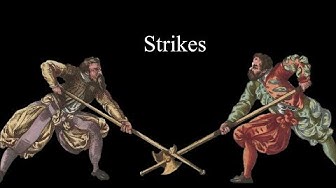
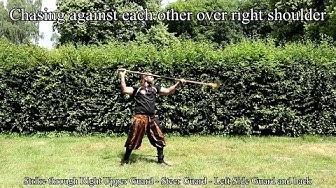
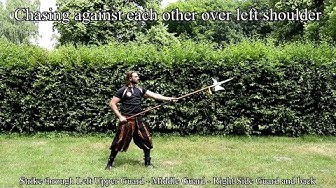
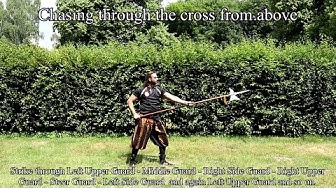
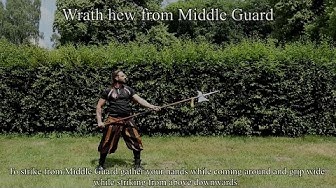
Pollarms such as the halberd, glaive and bill were developed during the high middle ages and rose to dominate the battlefield during the late middle ages. The skills required to use this weapon build on skills learned with the two handed spear, combing cuts and hooks with a spear's thrusts.
Two Handed Axe
From the dane axe of the early period to the pollaxe of the late period, two handed axes are devastating weapons for heavy infantry. Bolstering the power of an axe head with the leverage of two hands and a long haft, a blow from a two handed axe can be nigh unstoppable. The skills required to use this weapon build on skills learned with the single handed axe and the two handed spear.
Dagger
The knife or dagger is a ubiquitous tool and occasional sidearm used for fighting in very close quarters. Daggers are frequently employed was a backup option to supplement another weapon in close quarter combat. The skills required to use this weapon build on skills learned with the single handed sword, supplementing swordsmanship with close-quarter grappling.
Heater Shield
A development of the tower shield, the smaller heater lends itself to a hybrid combat style that incorporates both static and dynamic elements. Heater shields saw prominence with the knights of the high medieval period and continued to be used into the late medieval period. The skills required to use this shield build on skills learned with the round shield and kite shield.
Buckler
A shield small enough to wear on a swordbelt, the diminutive buckler saw use as a civilian self defence weapon during the late medieval and renaissance periods. The buckler relies on quick, darting defensive actions, even more so than the roundshield. The skills required to use this shield build on skills learned with the round shield and sword.
Advanced Weapons
Because they require significant training to use safely, these weapons are only taught to members who already have several months of experience at least.
Single Handed Spear
Used together with a shield, the short spear was a popular armament throughout the early and high middle ages due to its combination of sturdy defence with long-ranged offence. The skills required to use this weapon build on skills learned with the two handed spear and shield.
Two Handed Sword
Developed during the high medieval period and perfected during the late period, the longsword is surrounded by more martial arts tradition and mystique than any other european weapon. The skills required to use this weapon build on skills learned with the two handed axe and single handed sword.
Exercises
And how do you train with these weapons?
We train for both one-on-one "duel" style combat and team-on-team "battle" style combat. We use a variety of training exercises, but some of the more common exercises include:
Drill
We warm up at the beginning of each session and practice movements for new weapons using drills: pre-determined sequences of motions designed to cover the core attacks of a given weapon.
Sparring Exercises
The majority of training consists of standard sparring exercises. Duel practice between pairs of individual fighters allows us to hone our weapon skills. Skirmish practice between groups of two or three fighters allows us to practice small scale teamwork. Battle practice, in which the entire group divides into two teams, allows us to practice formation fighting and large-scale coordination.
Close Quarter Exercises
Close quarter exercises, in which combat space is intentionally restricted, allow practice for fighting in confined corridors or choke points. These can vary from close-quarter singles exercises to close-quarter doubles to entire close-quarter battles designed to simulate storming a bridge or gatehouse.
Free For All Exercises
These exercises pit fighters not only against one enemy at once but multiple threats simultaneously in a battle royale. These exercises promote alertness and situational awareness, as a threat may come from any side. We use both singles and groups free-for-all exercises.
Membership
And how much does all this cost?
£7. No, we're serious. £7 per year for all the medieval weapons you could possibly play with. Yeah, I didn't believe it either when I first joined. Best deal you'll see all day, take it or leave it. If you're not convinced, we run 2 taster sessions for free at the beginning of each academic year for you to come and see for yourself.
Committee
All of our clubs and societies are run by a committee.
A committee is a team of people that lead, organise and publicise a group within your Students’ Union.
It can be really rewarding as well as being a great way to gain experience and invaluable skills for your future career.


1.243 bình luận


Không có nhận xét nào:
Đăng nhận xét